

This tiny country is watching the US–Venezuela conflict closer than anyone.
Guyana, with boundless new oil riches, has been fighting off Venezuela's claims to its valuable territory for decades. Is the Trump administration's new push against Venezuela an opportunity?

American warships. Venezuelan troop mobilization. Deadly strikes against suspected drug traffickers.
The Trump administration is putting the screws to Nicolás Maduro, the authoritarian leader of Venezuela. Some worry of escalation. Others invite it.
What happens next is a guessing game.
What is certain, however, is that one country is grinning from the sidelines: Guyana.
Although few nations ring less of a bell in the mind of the American public, this English-speaking state on Venezuela’s eastern flank is rising at a pivotal moment.
Guyana has seen the fastest economic growth in the world. The International Monetary Fund (IMF) reported its real GDP jumped by 47% between 2022–2024.
Oil is at the heart of it.
In 2015, ExxonMobil discovered large amounts off the country’s northern shore, in an area known as the Stabroek Block. The U.S. Energy Information Administration now calls the country of 800,000 people a “key contributor to global crude oil supply growth.”
This development not only changed Guyana’s status on the world stage, it led neighboring Venezuela to renew its claim to two-thirds of the country’s territory — something it has wanted since the 19th century, when a tribunal in Paris decided on the current boundary between Venezuela and Guyana (then a British colony).
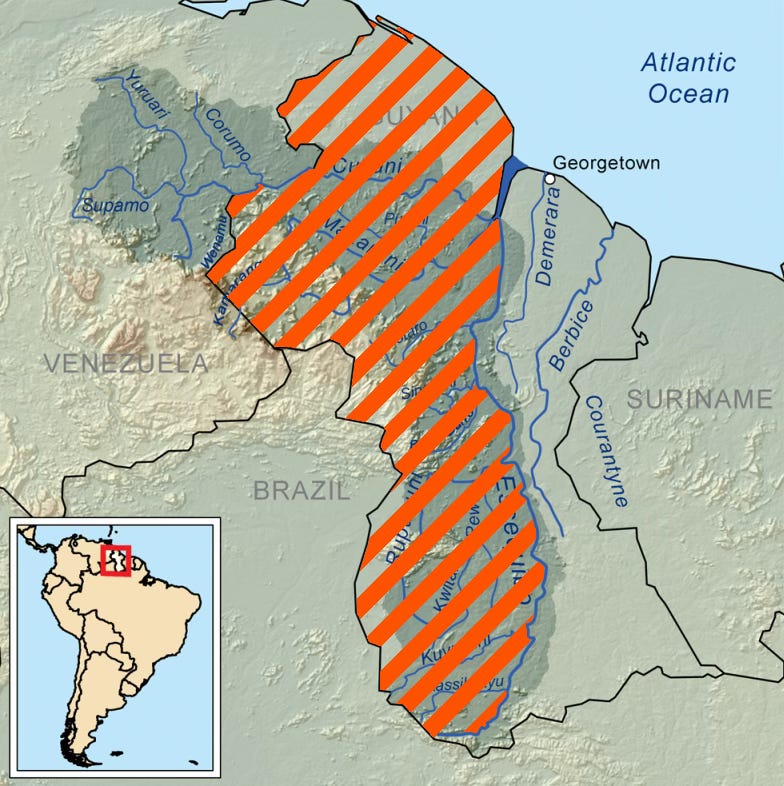
Maduro, facing a stagnating economy and popular unrest, recently ramped up the effort to assert sovereignty over the disputed territory (known as the Essequibo) in a way his predecessor Hugo Chávez did not, according to reporting from the New York Times. Not just with threats of force, but with the tools of government.
This May, Venezuela held an election to decide who will represent Essequibo in the nation’s government. Guyana condemned it as a sham — the U.S. did, too.
Secretary of State Marco Rubio has spoken several times with Guyana’s president, Irfaan Ali, this year. The discussions have touched on “the United States’ steadfast support of Guyana’s territorial integrity,” as a spokesperson said in January.
Now the Trump administration’s attention is fixed on Venezuela, with strikes and CIA operations.
For Guyana, this could prove a pivotal moment in repelling efforts from Caracas to meddle in the Essequibo.
If the American goal is to topple Maduro and invite new leadership in Venezuela, as some think it is, a window opens for Guyana to settle the border conflict and keep the oil riches of the Stabroek Block firmly and forever within the country’s borders.
A new regime in Caracas would likely not have the time or desire to keep up the heat in the Essequibo.
This stability offered here only increases the likelihood that Guyana could continue blockbuster economic growth, perhaps becoming something of a Gulf state of the Western Hemisphere.
On a business front, ExxonMobil would likely breathe easier without the constant threats from Venezuela on its operations in Guyana. In a rattle of the saber in September, Venezuela’s Defense Minister Vladimir Padrino Lopez warned of a “response” if his country is attacked from Guyanese territory, according to reporting on Military.com.
How much the oil company’s priorities are figuring into the president’s calculus isn’t yet clear.
One thing now seems certain: Guyana’s best chance to beat its biggest foreign threat is right now. The question in the Guyanese capital of Georgetown this evening may well be: How hard will the Americans push?